



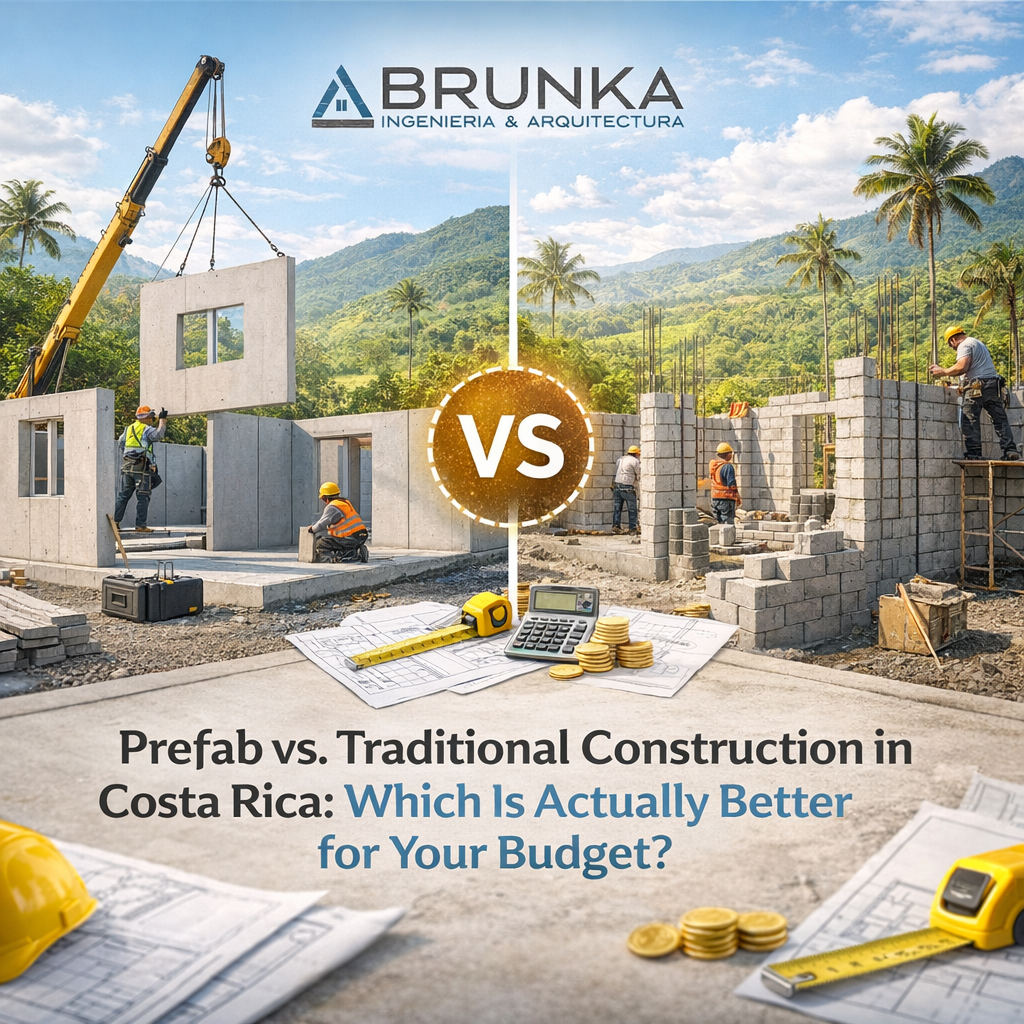
Prefab vs. Traditional Construction in Costa Rica: Which Is Actually Better for Your Budget?
Key Takeaways:
- Prefab in Costa Rica sounds cheap until the hidden costs show up. Location, terrain, and finishes change everything.
- Traditional concrete block construction still dominates the market for a reason: durability, flexibility, and resale value.
- Most expats and investors underestimate permit timelines, and that delay hits every construction method equally.
- Your lot’s terrain matters more than your build method when calculating the real total cost.
- Getting a licensed architect and engineer involved early is the single biggest thing you can do to protect your budget.
I’ve sat across from a lot of people who came to Costa Rica with a number in their head. A budget, a dream lot, and a YouTube video about prefab homes that made everything look simple.
Six months later, some of them are over budget. Some are still waiting on permits. And almost none of them built what they originally imagined, not because the dream was wrong, but because they picked a construction method before they understood the terrain, the regulations, or what “prefab” actually means down here.
Let me give you the honest breakdown.
What “Prefab” Really Means in Costa Rica
Forget the sleek modular homes you’ve seen in Scandinavian architecture blogs. In Costa Rica, prefab typically means pre-formed concrete panel systems assembled on-site. It’s not a factory-finished product shipped to your lot. It’s a faster assembly process using pre-made structural components, and there’s a significant difference.
The upside: lower labor cost and faster on-site assembly. A basic prefab structure can go up in weeks once groundbreaking happens.
The downside: design options are limited. You’re largely working with standard panel sizes, standard layouts, and basic finishes. If you want vaulted ceilings, custom kitchen cabinetry, or a wraparound terrace with valley views, prefab systems in Costa Rica aren’t really built for that.
For a small rental cabin, a guest house, or a budget starter home on flat, accessible land? Prefab can absolutely make sense. For a full residential home where livability and long-term value matter? You’ll hit the ceiling of what prefab can deliver pretty fast.
The Real Cost Breakdown Honest Numbers
Here’s where people get confused. They see a per-square-foot price for prefab that looks dramatically cheaper, and they stop reading. But the full picture looks different.
Prefab construction in Costa Rica typically runs between $50–$75 per square foot for basic panel systems with standard finishes. That number assumes flat land, an accessible road, no major site prep, and a simple layout.
Traditional reinforced concrete block, the backbone of Costa Rican residential construction, runs roughly $100–$170 per square foot depending on finish quality, design complexity, and location.
So yes, there’s a real price gap. But here’s what that prefab number doesn’t include: custom finishes, kitchen upgrades, water heater, proper drainage, any significant grading work, utility connections, or the cost overruns that come from working with a method that fewer local contractors specialize in.
Traditional construction, when you’re working with a licensed team that knows the process, tends to have fewer surprise line items because the workflow is familiar, the material suppliers are established, and the regulatory path is well understood.
If you want to explore what construction actually costs for your specific project type, the services page at Brunka Engineering breaks down exactly what’s included at each phase.
The Permit Timeline Nobody Warns You About
This is the part that catches almost everyone off guard, including people who’ve built homes in other countries.
In Costa Rica, your build method has almost zero effect on how long permitting takes. Municipal approvals, CFIA registration, environmental assessments, utility hookup applications, all of that runs on the same timeline whether you’re building with prefab panels or poured concrete.
Realistically, you’re looking at three to six months for permits before a single shovel hits the ground. From groundbreaking to move-in on a standard 2,000 sq ft home? Budget for eight to twelve months, minimum.
Anyone promising you a significantly faster total timeline based solely on prefab assembly is measuring the wrong part of the project.
Location Changes the Entire Equation
Costa Rica is a small country with wildly different building conditions depending on where you’re buying.
Building in the Central Valley near San José? You have good access to materials, established contractors, and competitive pricing. A traditional mid-quality home might come in around $1,000–$1,300 per square meter.
Building in a beach town like Nosara, Santa Teresa, or Puerto Viejo? Expect to pay significantly more for imported materials, skilled labor is scarcer, and road access to your lot may require its own line item. Costs in those zones can easily reach $1,500–$2,000+ per square meter for a quality traditional build.
And if your lot is on a slope, which describes a huge percentage of the most desirable properties in Costa Rica, you’re adding retaining walls, drainage engineering, and site prep costs that apply regardless of whether you go prefab or traditional.
That’s exactly why reading about how Costa Rica homes are actually designed and engineered matters before you make any decisions about method. The variables on the ground don’t show up in the brochure.
Seismic Reality: This Isn’t a Minor Detail
Costa Rica sits directly on the Pacific Ring of Fire. Earthquakes aren’t hypothetical; they’re part of life here, and construction codes reflect that.
Traditional reinforced concrete block with proper seismic columns and tie beams is the established standard for a reason. The structural logic is proven, the local engineers know how to execute it, and inspectors know what to look for.
Prefab systems can be engineered to meet seismic standards, but it requires more diligence to verify that the specific system you’re using has been properly rated and reviewed by a CFIA-licensed structural engineer. Don’t assume. Ask, and get it in writing.
This is one of the clearest reasons why working with a licensed architect-engineer team from day one isn’t optional; it’s the difference between a home that performs and one that becomes a liability.
So Which One Should You Actually Choose?
Prefab makes sense when:
- You’re building something small, a studio, a rental cabin, a guest unit
- Your lot is flat with easy road access
- Budget is the primary constraint, and finish quality is flexible
- Timeline for the actual assembly (not permits) genuinely matters to your situation
Traditional construction makes more sense when:
- You’re building a full residential home, you plan to live in or sell
- Your lot has any slope, drainage challenge, or complex access
- You care about resale value and bank financing later
- You want design flexibility, custom layouts, ceiling heights, and finishes
- You’re building near the coast, where moisture resistance and longevity matter
For most people building in Costa Rica with a serious investment in mind, traditional construction managed by the right team still delivers better value over the full lifespan of the home. The slightly higher per-square-foot cost tends to pay for itself in fewer surprises, better durability, and a stronger resale position.
The team at Brunka Engineering has worked on both methods across different regions of Costa Rica, and they’ll tell you honestly which one fits your specific lot, budget, and goals before you commit to anything.
FAQ: Your Questions Answered
Q: Is prefab construction legal in Costa Rica?
Ans: Yes, fully legal, but it still needs CFIA approval and must meet seismic standards like any other build.
Q: How much cheaper is prefab vs. traditional?
Ans: Roughly 40–50% less upfront. But once you add finishes, site prep, and utility hookups, that gap closes fast.
Q: Can I customize a prefab home here?
Ans: A little basic layouts and finishes, yes. Anything custom? Traditional construction gives you far more freedom.
Q: Does prefab mean faster permits?
Ans: No. Permits take 3–6 months regardless of your build method. That timeline doesn’t change.
Q: Do I need a licensed architect for prefab, too?
Ans: 100% yes. Every build in Costa Rica, prefab or traditional, requires a CFIA-registered professional. No exceptions.
Ready to Build in Costa Rica the Right Way?
The biggest construction mistakes in Costa Rica aren’t about choosing the wrong method. They’re about starting without the right team.
Brunka Engineering is a Costa Rica-based firm of licensed architects and engineers with real project experience across the country, from beach houses in Guanacaste to hillside homes in the Central Valley. They handle architectural design, structural engineering, permits, project management, and construction oversight under one roof.
Whether you’re comparing methods, pricing out a lot, or ready to break ground, they’ll give you straight answers before you commit to anything.
📞 WhatsApp / Phone: (506) 8783-0001 📧 Email: in.design@gmail.com 🌐 Website: architectengineer.cr
Your budget deserves better than guesswork. Talk to Brunka before you build.